YouTube Doubles YPP Requirements: 8,000 Watch Hours or 20M Shorts Views from February 2027
By Alex Reed··4 min read
YouTube is making the first significant change to the Partner Program since 2018, and the headline is a doubled entry bar: from February 1, 2027, new creators will need 8,000 qualified watch hours in 12 months or 20 million qualified Shorts views in 90 days, on top of 1,000 subscribers. Creators already in YPP are not affected. Here is the full picture — including the part most coverage skips.
Takes effect
February 1, 2027
New entry bar
1,000 subs + 8,000h or 20M Shorts views
Shorts revenue gate
10M views / 90 days
Existing partners
Unaffected
Old vs New Entry Requirements
| Requirement | Now | From Feb 1, 2027 |
|---|---|---|
| Subscribers | 1,000 | 1,000 |
| Qualified public watch hours (12 months) | 4,000 | 8,000 |
| Qualified Shorts views (90 days) | 10 million | 20 million |
| Fan Funding & Shopping entry | Lower tier | Unchanged |
The subscriber count does not move, and the lower tier that unlocks Fan Funding and Shopping is untouched — this change is only about the ads-and-Premium leg of YPP.
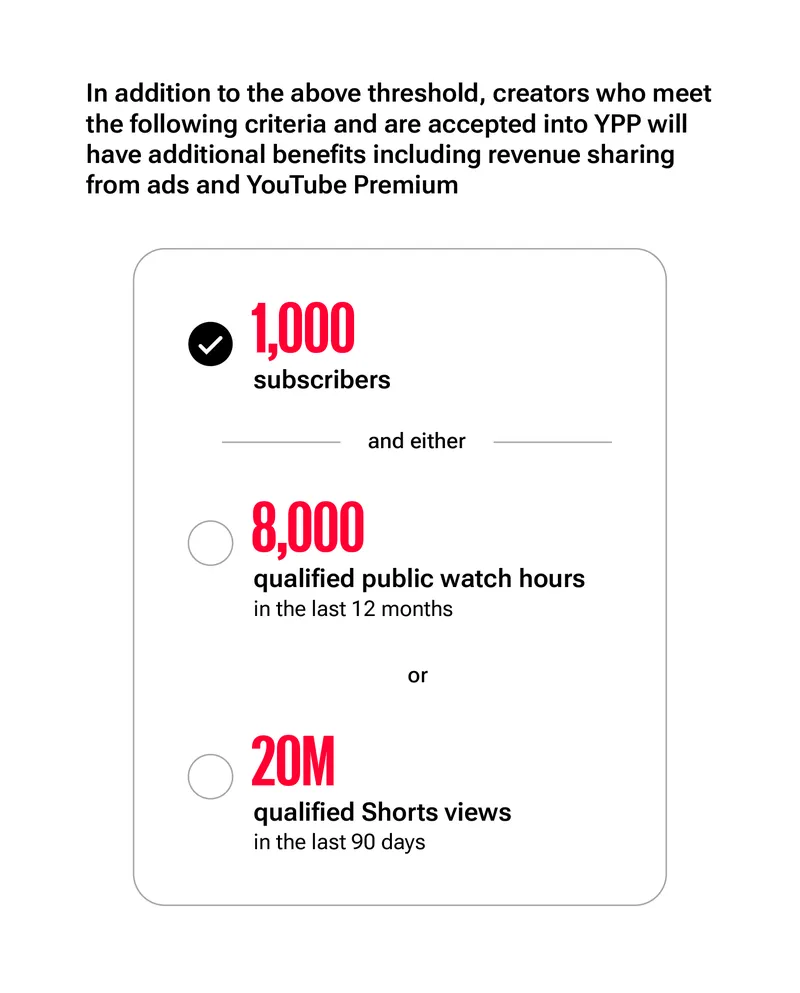
YouTube's own breakdown of the new criteria for ads and Premium revenue sharing. Image: YouTube.
The Shorts Rule Everyone Is Conflating
The 20 million figure is the entry bar for new applicants. There is a second, separate threshold that applies to everyone, including long-standing partners: from February 1, 2027 a channel needs 10 million qualified Shorts views over the last 90 days to be eligible for ads and subscription revenue sharing on Shorts.
Falling under it is not an expulsion. You stay in YPP, keep earning on long-form, and Shorts revenue sharing switches back on automatically once you climb back over 10 million. YouTube says creators already earning significant Shorts revenue are unlikely to notice.
For channels under that line, YouTube is promising replacements rather than ad revenue: bonuses tied to YouTube Shopping, incentives for brand deals, and earnings boosts for starting and growing trends. None of it is detailed yet — that is the part worth watching, because it decides whether this is a cut or a reshuffle.
The Other Half: Premium Lite Goes Global
Premium Lite is expanding to every country where YouTube Premium is available. The mechanics: subscription money goes into dedicated pools — 30% of net subscription revenue for Premium and 60% for Premium Lite — split across creators by member watch time and views, with creators taking 55% on long-form and 45% on Shorts of what they are allocated.
YouTube's claim is that a viewer who subscribes is worth more to partners on average than the same viewer watching ads, based on 2026 performance. With over 3 million creators in YPP, the company says it expects to pay out more in 2027 than in 2026 — which is the argument for reading these changes as a redistribution toward active channels rather than a straight cut.
What It Means for New Creators
In practice the road to first ad revenue roughly doubles in length. 4,000 watch hours was already the slow lane — 8,000 puts monetization further out for exactly the creators for whom the first payout matters most, and the Shorts alternative jumping to 20 million views closes the fast route that small channels had been using. Reaction has been predictably rough: “This is going to be a devastating blow to small creators”, as creator DeepHumor put it in coverage by Dexerto, with vidIQ framing it more neutrally as raising the bar. Kick has already started courting the discontent.
Two things soften it. Fan Funding and Shopping keep their lower entry tier, so memberships, Super Thanks and product tagging remain reachable well before ad revenue. And there is nearly six months before anything changes — a channel at 4,000 hours today has until February 1 to double up. If you are weighing where to put that effort, our platform revenue-split comparison covers what each platform actually pays.
Frequently Asked Questions
What are the new YouTube Partner Program requirements?
From February 1, 2027, new applicants need 1,000 subscribers plus either 8,000 qualified public watch hours in the last 12 months or 20 million qualified Shorts views in the last 90 days. That doubles both of the old alternatives — 4,000 watch hours and 10 million Shorts views. The subscriber count is unchanged.
Do the new requirements affect creators already in YPP?
No. YouTube states the entry-threshold update does not impact creators already in the program. The separate Shorts revenue rule does apply to everyone, though, and existing partners will need to review and sign new terms in YouTube Studio before they take effect on February 1, 2027.
What is the new 10 million Shorts views rule?
It is a separate gate from joining YPP. From February 1, 2027, a channel needs 10 million qualified Shorts views over the previous 90 days to be eligible for ads and subscription revenue sharing on Shorts. Falling below it does not remove you from YPP — you keep earning on long-form content, and Shorts revenue sharing resumes automatically when you cross 10 million again.
What do creators below the Shorts threshold get instead?
YouTube says it is adding incentive programs rather than relying on ad revenue alone: bonuses tied to YouTube Shopping, incentives for brand deals, and earnings boosts for starting and growing trends. Details have not been published yet.
How does Premium Lite pay creators?
Premium Lite is expanding to every country where YouTube Premium is offered. Subscription revenue goes into dedicated pools — 30% of net subscription revenue for Premium and 60% for Premium Lite — distributed by member watch time and views, from which creators take 55% on long-form and 45% on Shorts. YouTube says partners on average earn more when a viewer subscribes than when that viewer was watching ads, based on 2026 performance.
Why is YouTube raising the bar?
YouTube frames it as keeping pace with its own scale — over 200 billion daily Shorts views and more than a billion hours of watch time on TV every day — and says the changes fund the new incentive programs. It is the first significant change to YPP since 2018, and the company says it expects to pay creators more in 2027 than in 2026.