What Is Live Streaming?
By Kenji Arai·
Live streaming is video that is created and broadcast at the same moment, with no finished file existing before it goes out. That single property is what separates it from everything else the word “streaming” is used for — Netflix and Spotify stream, but neither of them is live.
The short answer
Streaming is delivering media over the internet in a continuous flow, so playback starts in seconds instead of after a full download. It is an umbrella term covering three separate industries: live streaming (broadcast as it happens), video on demand (a pre-recorded catalogue) and music streaming (on-demand audio).
Livestreaming is one type of streaming, not a synonym for it. The difference is whether a finished file existed before you pressed play. Netflix streams but does not livestream. Twitch livestreams. YouTube does both.
The three kinds of streaming
Live streaming
Created and broadcast at the same moment.
- Examples
- Twitch, Kick, YouTube Live, TikTok LIVE
- How it earns
- Subscriptions, tips, ads, sponsorships
- How to tell
- You cannot watch it before it happens, and chat runs alongside it.
Video on demand (VOD)
A finished catalogue you choose from.
- Examples
- Netflix, Disney+, Prime Video, Hulu
- How it earns
- Subscription (SVOD), ads (AVOD), or free linear channels (FAST)
- How to tell
- Everything is already recorded, so you can start, pause and rewind at will.
Music & audio streaming
On-demand audio instead of video.
- Examples
- Spotify, Apple Music, YouTube Music, Amazon Music
- How it earns
- Subscription and advertising, paid out per stream to rights holders
- How to tell
- Measured in streams per track, and royalties are split with labels.
Streaming vs livestreaming: the actual difference
Both send media over the internet. The dividing line is whether the content already exists when you start watching.
| Livestreaming | On-demand streaming | |
|---|---|---|
| When it is made | As you watch it | Before you watch it |
| Can you skip ahead? | No — there is no 'ahead' yet | Yes, the whole file exists |
| Typical delay | 2–30 seconds behind reality | Not applicable |
| Interaction | Live chat, the streamer can respond | Comments after the fact |
| Who makes it | Mostly individual creators | Mostly studios and labels |
| Examples | Twitch, Kick, YouTube Live, TikTok LIVE | Netflix, Disney+, Spotify, Prime Video |
One wrinkle worth knowing: on livestreaming platforms the word VOD means something narrower — the saved recording of a broadcast that already aired. So a Twitch VOD is on-demand video of a live stream, which is exactly the kind of overlap that keeps the two terms tangled.
Live streaming: who is actually the biggest
The honest answer is that "biggest" depends on what you count, and the usual assumption — that livestreaming means gaming — is wrong at the platform level.
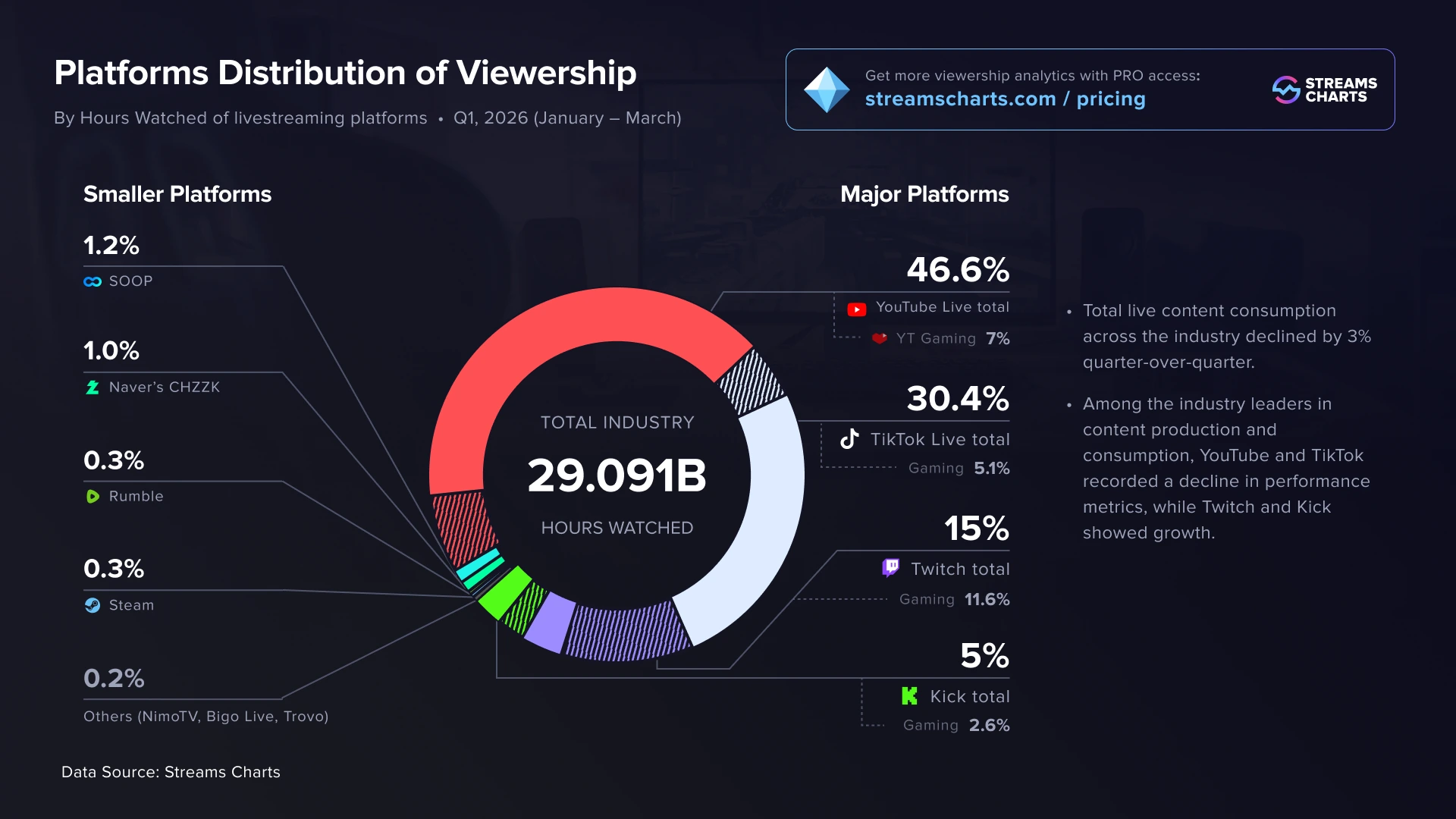
That chart is also the reason the table below is not a ranking of the whole industry. TikTok Live is the second-largest live platform at 30.4% of hours watched, ahead of Twitch — but it is measured differently and is not in the per-channel dataset the table draws on, so we have left it out rather than mix sources. Read the table as a close look at the three platforms most creators actually choose between.
| Platform | Hours watched | Avg concurrent viewers | Channels streaming | Top category |
|---|---|---|---|---|
| YouTube Live | 5.62B | 138 | 681,000 | Sports (28%) |
| Twitch | 1.42B | 48 | 3,008,000 | Just Chatting |
| Kick | 527M | 158 | 320,000 | Just Chatting |
Full month of June 2026, measured by Streams Charts. Concurrent viewers are airtime-weighted averages across all channels, so they are far below what a top channel pulls. China-based platforms are excluded.
Three things this table shows
YouTube Live is mostly not gaming.
Gaming was about 4.7% of YouTube's live watch time in June 2026, and 7% across Q1. Live sport took 28% of June, entertainment 21% and news and politics 16%. YouTube leads live streaming overall while being a minor gaming platform relative to its own size.
Twitch's biggest category is not a game either.
Just Chatting led Twitch with roughly 207 million hours watched, ahead of Counter-Strike (87M) and League of Legends (78M). Livestreaming drifted toward talking to an audience rather than playing for one.
Kick trades breadth for concentration.
Kick had roughly a tenth of Twitch's channel count but a higher average concurrent audience — 158 against 48. Its watch time is packed into fewer, larger channels, which is a different opportunity than it first appears for a newcomer.
Want the platform-by-platform breakdown with revenue splits and follower requirements? That is a separate guide: every livestreaming platform for creators, compared — including which ones have shut down or stopped paying.
Video on demand: Netflix, Disney+ and the TV side
This is what most people mean by "streaming services" — a pre-recorded catalogue funded by subscriptions or advertising. It is a studio business, not a creator business: you cannot sign up and publish to Netflix.
A caution about numbers you will see quoted elsewhere: Netflix stopped reporting quarterly subscriber counts from Q1 2025, and now announces only occasional milestones. Its last regular quarterly figure was 301.6 million paid subscribers for Q4 2024, reported in January 2025. Disney has likewise wound down routine subscriber disclosure, with Disney+ last reported at roughly 131.6 million. Any article presenting a precise, current subscriber count for either is reusing an old number or an estimate.
Music and audio streaming
Same on-demand model as Netflix, different medium — and a different economy. Music streaming pays rights holders per stream, so the unit of value is a play rather than a subscription month, and the money is split with labels and publishers before it reaches an artist.
Spotify is the scale reference: 761 million monthly active users and 293 million paying subscribers as of Q1 2026, on quarterly revenue of €4.53 billion. Note the gap between those two numbers — roughly 60% of listeners never pay, which is why the advertising tier matters so much in audio and so little in SVOD.
Podcasts sit here too, and they are the one place the three worlds meet: a podcast can be recorded on demand, distributed like music, and livestreamed to a chat while it happens. Plenty of creators do all three from one session.
How streaming works, briefly
Media is encoded into a compressed format, cut into chunks of a few seconds, and served over HTTP using an adaptive protocol — usually HLS or DASH. Your player pulls chunks slightly ahead of playback into a buffer and switches quality levels as your bandwidth moves, which is why picture quality softens instead of stopping outright.
Live streaming adds a step at the front. The broadcaster's encoder pushes video to the platform over RTMP, SRT or WebRTC; the platform transcodes it into those same chunks and fans them out through a CDN. That extra encoding and distribution work is the reason a live stream runs seconds behind reality, and why "low latency" modes trade stability for speed.
The practical version of this for broadcasters — what bitrate and encoder to pick, and the caps per platform — is in the bitrate and encoder cheat sheet.
Which one did you mean?
This site covers the live streaming side — creators broadcasting to an audience. If that is what brought you here, start with one of these.
I want to start broadcasting
Platform choice, gear and first stream
I want to compare platforms
All 13, with revenue splits and status
I need equipment
Mics, cameras, lighting and more
I need to set up software
OBS Studio settings that matter
Looking for something to watch on Netflix or a music subscription instead? That is the on-demand side of the word and not what we cover — this guide exists mainly so you can tell the two apart quickly.
Frequently Asked Questions
What is live streaming?
Live streaming is video created and broadcast at the same moment, with no finished file existing beforehand. A camera or capture card feeds an encoder (OBS, Streamlabs, a hardware unit), the encoder compresses the signal and pushes it to a platform's ingest server over RTMP or SRT, the platform transcodes it into several quality levels, and a CDN delivers those to viewers — normally 2 to 30 seconds behind reality. Because nothing is finished in advance, live content cannot be edited before release or watched before it happens.
How does live streaming work, step by step?
Five stages. Capture: a camera, microphone or the game itself produces the raw signal. Encode: software such as OBS compresses it to H.264 or AV1 at a chosen bitrate and resolution. Ingest: the encoder uploads one stream to the platform over RTMP or SRT. Transcode: the platform makes multiple quality versions so viewers on slow connections can still watch. Deliver: a CDN sends the closest copy to each viewer. Every stage adds delay, which is why chat reacts a few seconds after what you see.
How much latency does live streaming have?
Typically 2 to 30 seconds between what the broadcaster does and what a viewer sees. Standard Twitch or YouTube latency sits around 10 to 20 seconds; low-latency modes bring it to roughly 2 to 5 seconds at the cost of less buffer for unstable connections. Anything that needs real conversation — an interview, a co-op game with the audience — needs the low-latency mode; anything where smoothness matters more than immediacy does not.
What is streaming?
Streaming is delivering media over the internet in a continuous flow, so playback starts within seconds instead of waiting for a full download. The word covers three separate industries that share only that delivery method: live streaming (broadcast as it happens, like Twitch or Kick), video on demand (a pre-recorded catalogue you pick from, like Netflix), and music or audio streaming (like Spotify). When people disagree about "streaming", they are usually talking about different ones of these three.
What is the difference between streaming and livestreaming?
Livestreaming is one type of streaming. Streaming is the umbrella term for any media delivered in real time over the internet, including pre-recorded content. Livestreaming specifically means the content is created and broadcast simultaneously, with no finished file existing beforehand — so it cannot be paused at the source, edited before release, or watched before it happens. Netflix streams but does not livestream. Twitch livestreams. YouTube does both.
Is Netflix livestreaming?
No, with narrow exceptions. Netflix is a subscription video-on-demand service: its catalogue is pre-recorded and encoded before you press play. Netflix has run occasional genuine live events, such as live sport and comedy specials, but its core product is on-demand. If you are looking for a platform to broadcast yourself in real time, Netflix is not one.
Is Spotify streaming?
Yes. Spotify is audio streaming — music and podcasts delivered on demand rather than downloaded. It sits in the same broad category as Netflix (on-demand, subscription-funded) but in audio rather than video. Spotify reported 761 million monthly active users and 293 million paying subscribers in Q1 2026.
What does VOD mean?
VOD stands for video on demand: pre-recorded video you can start at any time. The industry splits it by funding model — SVOD is subscription-funded (Netflix, Disney+), AVOD is advertising-funded (the free tiers of YouTube or Tubi), and FAST means free ad-supported streaming TV, which mimics linear channels you scroll through rather than a catalogue you search. On livestreaming platforms, "VOD" also means the recording of a past live broadcast.
Which livestreaming platform is the biggest?
YouTube Live, by a wide margin: it took 46.6% of all livestreaming hours watched in Q1 2026, out of an industry total of 29.091 billion hours. TikTok Live is second at 30.4%, ahead of Twitch at 15%, with Kick at 5%. But the ranking flips for gaming — only 7% of YouTube's share is gaming, against 11.6% of Twitch's 15%, so most of Twitch is gaming while most of YouTube Live is live sport, entertainment and news. For gaming specifically, Twitch is still the centre of gravity.
How does streaming work technically?
The source media is encoded into a compressed format, split into small chunks of a few seconds each, and served over HTTP using an adaptive protocol such as HLS or DASH. Your player downloads chunks slightly ahead of playback into a buffer and switches between quality levels as your bandwidth changes — which is why video briefly softens instead of stopping. Live streaming adds an ingest step: the broadcaster's encoder pushes video to the platform over RTMP, SRT or WebRTC, which then transcodes it into those chunks. That extra work is why live streams run a few seconds behind reality.
Do I need different software for livestreaming than for watching?
Yes. Watching needs nothing beyond a browser or app. Broadcasting needs encoder software that captures your screen, camera and audio and pushes them to a platform — OBS Studio is the free standard, with Streamlabs and platform-native apps as alternatives.