Budget Streaming Setup: Mic, Webcam, Lighting and Green Screen for $150, $300 or $500
By Dan Whitfield··11 min read
Game streaming on a budget starts at about $140: a FIFINE K669B USB mic, a Logitech Brio 101 webcam, a 10-inch ring light and a green screen cloth on a stand. At about $300 you get a dynamic mic on a boom arm, the Logitech C920x and closed-back headphones; just under $500 buys a 1080p60 webcam and a pull-up green screen with its own lights. The streaming software, OBS Studio, is free.
Disclosure: We earn a commission from Amazon links on this page, at no extra cost to you. Every link goes to the exact model named, checked for stock on Amazon US. Prices change; checked September 2026.
The Three Builds at a Glance
Each column is a complete setup for streaming games from a PC you already own. Pick the column that fits your budget; every part links to the exact listing. The ring light stays in all three, and the $300 and $500 builds share the same mic, arm and headphones, so moving from $300 to $500 later means buying only the camera, the two panels and the screen.
| Part | $150Starter | $300Balanced | $500Full green screen |
|---|---|---|---|
| Microphone |
|
|
|
| Mic mount | Included desk tripod |
|
|
| Webcam |
|
|
|
| Lighting | |||
| Green screen | |||
| Headphones | Wired earbuds you already own | ||
| Total | about $140 | about $301 | about $495 |
Totals add up the rounded Amazon US prices we saw in September 2026. Streaming from a console? Add a USB capture card (around $27) to any build — more on that below.
What to Spend On First
- Microphone. Viewers forgive a soft picture; they leave over bad audio. A real mic is the first $33 you spend.
- Light. A $37 ring light can make a $38 webcam look better than a $110 webcam in a dark room, because webcam sensors are small and turn grainy without light.
- Webcam. Only after the light is sorted does a better camera show its difference.
- Green screen. Optional, and it only works once the lighting is right.
- Headphones. Any wired pair works on day one; closed-back ones stop game sound leaking into your mic.
Microphone: Budget Mic Setup for Game Streaming
Two mics cover every budget. The FIFINE K669B is a USB condenser: sensitive and clear, but it also hears your keyboard, so it needs to sit close to your mouth and away from the keys. The FIFINE AmpliGame AM8 is a dynamic mic, which is why it goes in the $300 and $500 builds: dynamic capsules only pick up what is close, so a mechanical keyboard and a noisy room drop right back. It also has a tap-to-mute button, a headphone jack for monitoring, and an XLR output for when you add an audio interface later (the XLR cable is not included).
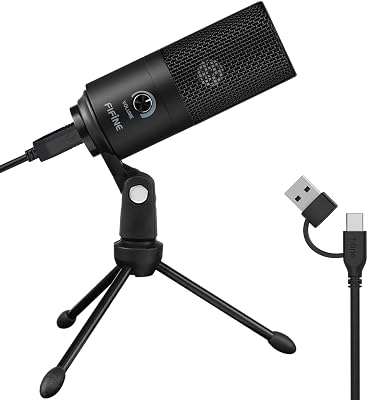
FIFINE K669B
USB condenser, cardioid, metal body, volume knob, desk tripod
Plug it in and talk. The cheapest mic that clearly beats a headset or webcam mic.
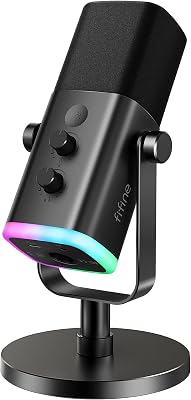
FIFINE AmpliGame AM8
Dynamic, cardioid, USB and XLR, tap-to-mute, gain knob, headphone jack
A dynamic capsule hears your mouth and ignores most of the keyboard and the room. XLR means you can add an interface later without replacing the mic.
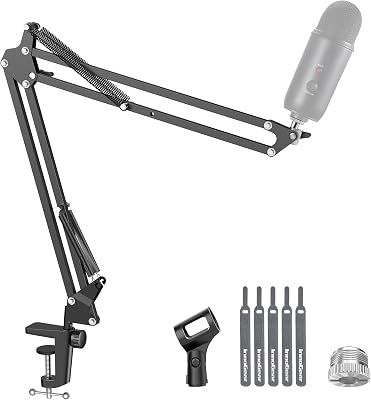
InnoGear boom arm
Clamps to flat desk edges up to 2 in thick, carries up to 3.3 lb
Puts the mic a few inches from your mouth and off the desk, where it would pick up every keystroke.
Placement matters more than the mic. Put a condenser 6–8 inches from your mouth and a dynamic 2–4 inches away, both pointed at your mouth and away from the keyboard. In OBS, add the Noise Suppression filter to the mic, then set the volume so your loudest laugh peaks around -10 dB on the audio mixer and never touches 0. The full walk-through, including a noise gate and compressor, is in our OBS setup guide; more expensive options are compared in the streaming microphones hub.
Webcam: Budget Webcam Setup for Live Streaming
The facecam in a gaming layout is small, so 1080p at 30 fps is plenty. The Brio 101 is the floor: Full HD, automatic light balance and a built-in privacy shutter. The C920x adds autofocus, a 78° field of view and stereo mics, and its Amazon listing currently bundles a 3-month XSplit VCam license for background removal without a green screen. The Facecam MK.2 is the one real upgrade: uncompressed 1080p at 60 fps over USB 3.0 and manual exposure in Elgato's Camera Hub. It has no microphone at all, which is fine — you should not stream with a webcam mic anyway.
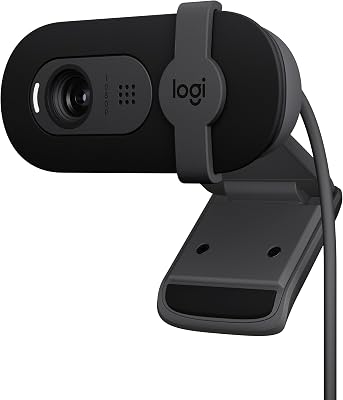
Logitech Brio 101
1080p, RightLight auto-light balance, built-in privacy shutter
The cheapest name-brand 1080p webcam we would put on stream.
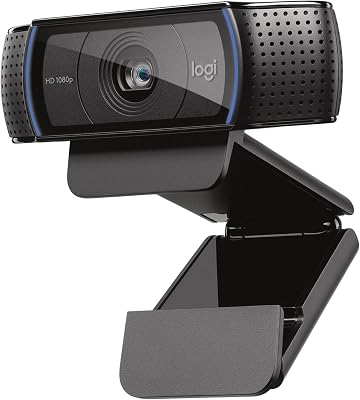
Logitech C920x
1080p at 30 fps, autofocus, 78° field of view, stereo mics
The default streaming webcam for years: autofocus, natural color, and every app recognizes it.
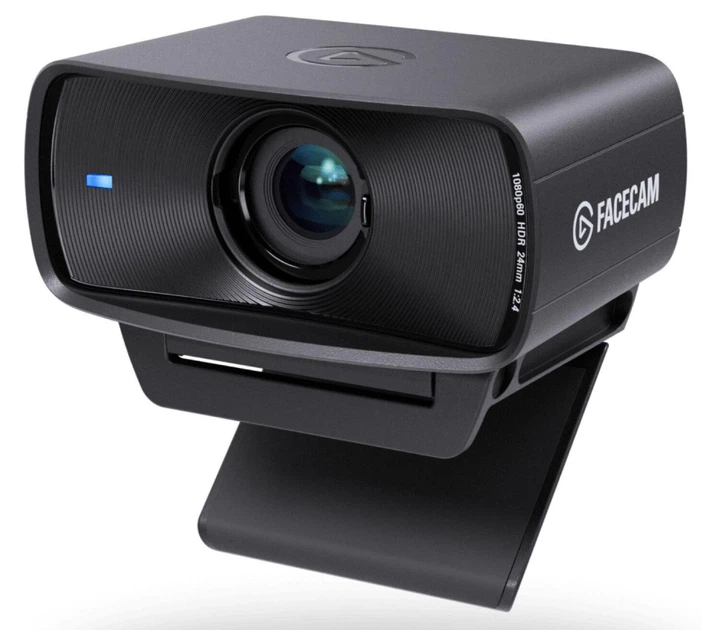
Elgato Facecam MK.2
1080p60 uncompressed over USB 3.0, HDR at 1080p30, Sony STARVIS sensor, no built-in mic
Smooth 60 fps motion and manual exposure in Camera Hub, so your face does not pulse brighter and darker with the game.
Settings that matter: in OBS open the Video Capture Device's Properties, set Resolution/FPS Type to Custom and pick 1920x1080 at 30 fps (60 on the Facecam). Then turn off auto exposure and auto white balance — on Windows via the Configure Video button in the same window, on the Facecam in Camera Hub — so the image stops shifting every time the game flashes. Mount the camera at eye level on top of the monitor. If you would rather use a phone as your camera, our IRL streaming gear guide covers phone rigs; dedicated cameras are compared in the webcams and cameras hub.
Lighting: Budget Lighting Setup for Streaming
The NEEWER RH10B ring light is the key light in all three builds. It sits on its own floor stand, so it does not take desk space, and it dims from 0 to 100% with color temperature from 2900 K (warm) to 7000 K (cool). Put it directly in front of you, just above eye level, and match its color to the room light so your face and the background do not look like two different photos. If you wear glasses, raise it and move it a little to one side so the ring reflection leaves your lenses.
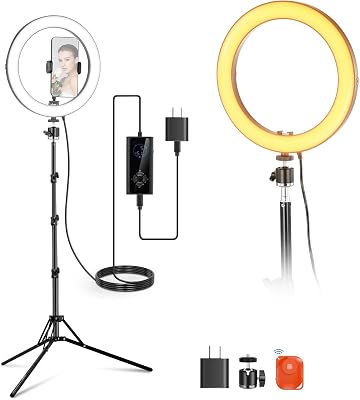
NEEWER RH10B 10-inch ring light
20 W, 2900–7000 K, 0–100% dimming, stand adjusts 21–71 in
One soft light in front of you does more for a cheap webcam than a pricier webcam does.
The BP66 two-pack only joins in the $500 build, and its job is the green screen, not your face. Two small USB-powered panels, one each side, aimed at the screen, give it the even light a clean key needs. Without a green screen, the same pair works as a soft fill light on either side of your monitor. For bigger panels and Elgato key lights, see the streaming lighting hub.
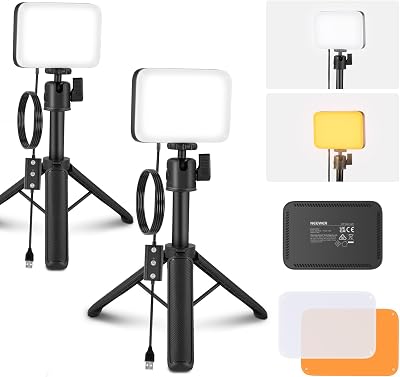
NEEWER Basics BP66 LED panels (2-pack)
Two USB-powered panels, up to 750 lux at 0.5 m each, CRI 95, desk stands 8.3–21 in
In the $500 build these light the green screen, not you, which is what makes the key clean.
Green Screen: Budget Green Screen Setup
All three types below key equally well once they are flat and evenly lit. What you pay for is setup time and wrinkles. Elgato's own collapsible Green Screen, which earlier versions of this guide recommended, is listed as currently unavailable on Amazon US (checked September 2026), so the $500 build uses EMART's panel with the same pull-up, locking-frame design.
| Type | Pick | Setup | Best for |
|---|---|---|---|
| Cloth on a T-stand | EMART green screen kit with T-stand ~$32 | 5–10 min; clamp and smooth | Tightest budget, a spot you can leave it up |
| Pop-up (spring frame) | NEEWER collapsible green screen ~$53 | Under a minute; lean or hang | Small rooms, packing it away after streams |
| Pull-up panel | EMART pull-up green screen ~$170 | Seconds; stands on the floor | Daily streams, no wrinkles ever |
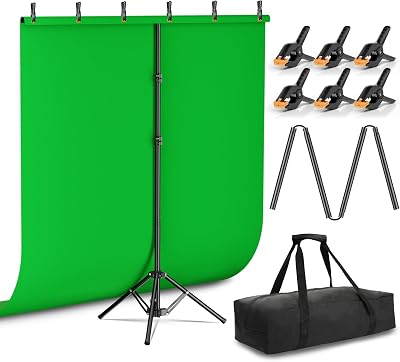
EMART green screen kit with T-stand
5×6.5 ft cloth, stand 4–6.5 ft tall, 6 clamps, washable
The cheapest route to a full-size screen. Clamp it tight and steam the creases out once.
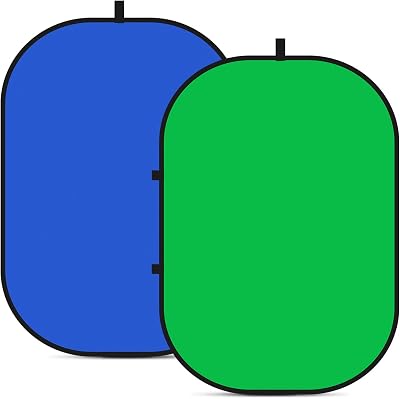
NEEWER collapsible green screen
5×6.5 ft, green/blue reversible, spring frame folds to a 25.6 in disc
The sewn-in frame keeps the fabric taut: fewer wrinkles and a faster setup than loose cloth.
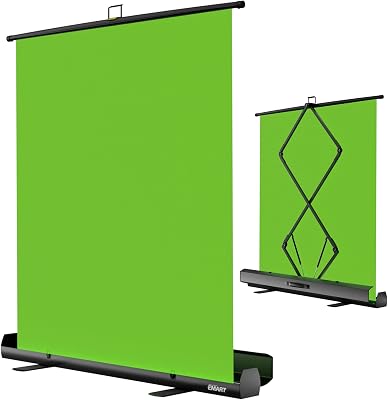
EMART pull-up green screen
58×74 in, locking X-frame, retracts into its own hard case
The Elgato-style design: up in seconds, packed away in seconds, no wrinkles. Worth it if you set up and tear down every stream.
How to set up and light a budget green screen
- 1Put the screen 3–6 ft behind your chair. Elgato's help center recommends 1–2 m (3–6 ft) between you and the screen and warns that too close or too far makes lighting harder: too close and your shadow and green reflections land on you.
- 2Get the fabric flat. Clamp cloth tight along the top, weigh or clamp the bottom and steam out the fold lines. Pop-up and pull-up screens stay taut on their own.
- 3Light the screen evenly, separately from you. Broad, soft light across the whole screen with no bright spot in the middle. In the $150 and $300 builds that is your ceiling light; in the $500 build the two BP66 panels sit left and right, aimed at the screen.
- 4Light yourself from the front. The ring light goes in front of you, slightly above eye level, pointed at your face, not at the green. You should be a little brighter than the screen.
- 5Key it in OBS. Right-click the webcam source → Filters → under Effect Filters click + → Chroma Key. Start from the defaults (Similarity 400, Smoothness 80, Key Color Spill Reduction 100) and raise Similarity only until the green is gone.
The lighting rules come from Elgato's chroma key help article and the filter defaults from the OBS knowledge base. The last piece is you: anything green on you gets keyed out too, so check our list of colors not to wear with a green screen before your first stream.
No room for a green screen?
Software can cut you out instead. NVIDIA Broadcast's virtual background runs on a GeForce RTX 2060, Quadro RTX 3000, TITAN RTX or newer, according to NVIDIA's FAQ, and appears in OBS as a regular camera. It is free and good enough for a facecam in a corner; a real screen still wins on hair, headset edges and fast movement.
Headphones
In the $150 build, use whatever wired earbuds you own. From $300 up, the ATH-M20x earns its place: the closed-back cups stop game audio from leaking into a mic sitting a few inches away, and the cable means no Bluetooth delay between what you see and what you hear. Avoid open-back headphones next to a sensitive mic for the same reason. Gaming headsets with their own mics are in the headsets hub.
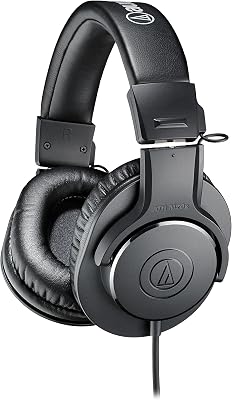
Audio-Technica ATH-M20x
Closed-back, over-ear, 40 mm drivers, wired
Closed-back cups keep game audio out of your mic, and a wire means no Bluetooth delay.
Streaming From a Console
OBS captures PC games directly, so none of the builds above include a capture card. To stream a PS5, Xbox or Switch through your PC, you need one between the console and the PC. A USB 1080p60 card with HDMI loop-out is enough for a first setup: the console plugs into the card, the card passes the picture on to your TV or monitor and sends a copy to OBS. When you want 4K capture, HDR or high-refresh passthrough, our capture card guide and the capture cards hub compare the options.
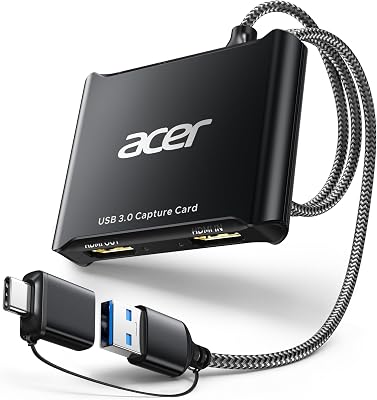
acer USB 3.0 HDMI capture card
1080p60 capture, 4K HDMI loop-out
Console streamers only: gets a PS5, Xbox or Switch picture into OBS on your PC.
Software: $0
OBS Studio is free and open source, streams to Twitch, YouTube, Kick or any other RTMP service, and handles everything in this guide: mic filters, webcam settings and the chroma key. Set it up once with our OBS setup guide and the bitrate and encoder cheat sheet; other free and paid apps are compared on our streaming software page. If this is your first stream, start with how to start streaming for accounts, stream keys and what to do in the first month.
Budget Setup Mistakes That Cost the Most
- Buying the webcam before the light. In a dim room the more expensive camera still looks grainy.
- A condenser mic on the desk next to a mechanical keyboard. Get it on an arm and close to your mouth, or buy a dynamic mic.
- Sitting against the green screen. Your shadow and green light bouncing onto your shoulders ruin the key; 3–6 feet of space fixes both.
- Wireless earbuds for monitoring. The Bluetooth delay makes it hard to tell whether your stream audio is in sync.
- A capture card for PC games. OBS already captures them; the card only helps consoles.
After $500: What to Upgrade Next
Upgrade in the order the problems show up. If your voice is the weak spot, use the AM8's XLR output with an audio interface (see the audio interfaces hub). If your face is, add a second light before a new camera, then move to a mirrorless camera through a camera capture device. If switching scenes is the pain, a stream deck is worth it. Everything else in the gear section can wait until the channel pays for it.
Frequently Asked Questions
What is the best budget streaming setup?
For most game streamers it is the $300 build: a FIFINE AmpliGame AM8 dynamic mic on an InnoGear boom arm, a Logitech C920x webcam, a NEEWER 10-inch ring light, a NEEWER collapsible green screen and Audio-Technica ATH-M20x headphones, with OBS Studio as free software. It fixes the three things viewers notice first — audio, light and a steady picture — without paying for features a new channel does not use yet.
How much does a budget streaming setup cost?
About $140 for the essentials (USB mic, 1080p webcam, ring light, green screen cloth), about $300 for a complete desk setup with a dynamic mic, boom arm and closed-back headphones, and just under $500 for a 1080p60 webcam and a pull-up green screen with its own lights. Those are Amazon US prices checked in September 2026 and they move. It assumes you already own the PC; the software is free.
What is the best microphone for game streaming on a budget?
A USB dynamic mic such as the FIFINE AmpliGame AM8 (around $57) on a boom arm. Dynamic capsules pick up your voice close up and reject much of the keyboard, mouse clicks and room echo, which matters more for gaming than raw detail. If you can only spend around $33, the FIFINE K669B USB condenser is the pick, but keep it close to your mouth and away from the keyboard.
What is the best budget webcam for live streaming?
The Logitech C920x (1080p30, autofocus, around $70) is still the safe default. The Logitech Brio 101 (around $38) is the cheapest 1080p webcam worth using on stream, and the Elgato Facecam MK.2 (around $110) is the step up for smooth 1080p60 and manual exposure. Whichever you buy, a $37 ring light improves the picture more than moving up a webcam tier.
Do I need a green screen to stream?
No. A green screen is only for cutting your background out so your camera can float over the game. Without one you can use NVIDIA Broadcast's virtual background, which NVIDIA says needs a GeForce RTX 2060, Quadro RTX 3000, TITAN RTX or better and shows up in OBS as a camera. A real green screen still gives cleaner edges around hair and fast movement, and costs from about $32.
How do I light a green screen on a budget?
Light the screen and yourself separately. Put the screen 3–6 feet behind you, get the fabric flat, and cover it with broad, even light with no hot spot; a ceiling light often does it, or two small LED panels aimed at the screen from the sides. Then light your face from the front with a ring light. Do not wear green, and keep shiny or green objects out of frame.
Do I need a capture card for game streaming?
Only if the game runs on a console. PC games are captured by OBS directly, so a capture card does nothing for them. To stream a PS5, Xbox or Switch through your PC you need one; a USB 1080p60 card such as the acer USB 3.0 HDMI capture card costs around $27, and pricier cards add 4K capture, HDR and high-refresh passthrough.
Is a ring light good for streaming?
Yes, as your main (key) light: it is soft, sits in front of you and removes the shadows a desk lamp or monitor glow creates. If you wear glasses, raise it and move it slightly off to one side so the ring reflection leaves your lenses. Once you add a green screen, the next light you buy should go on the screen, not on you.